
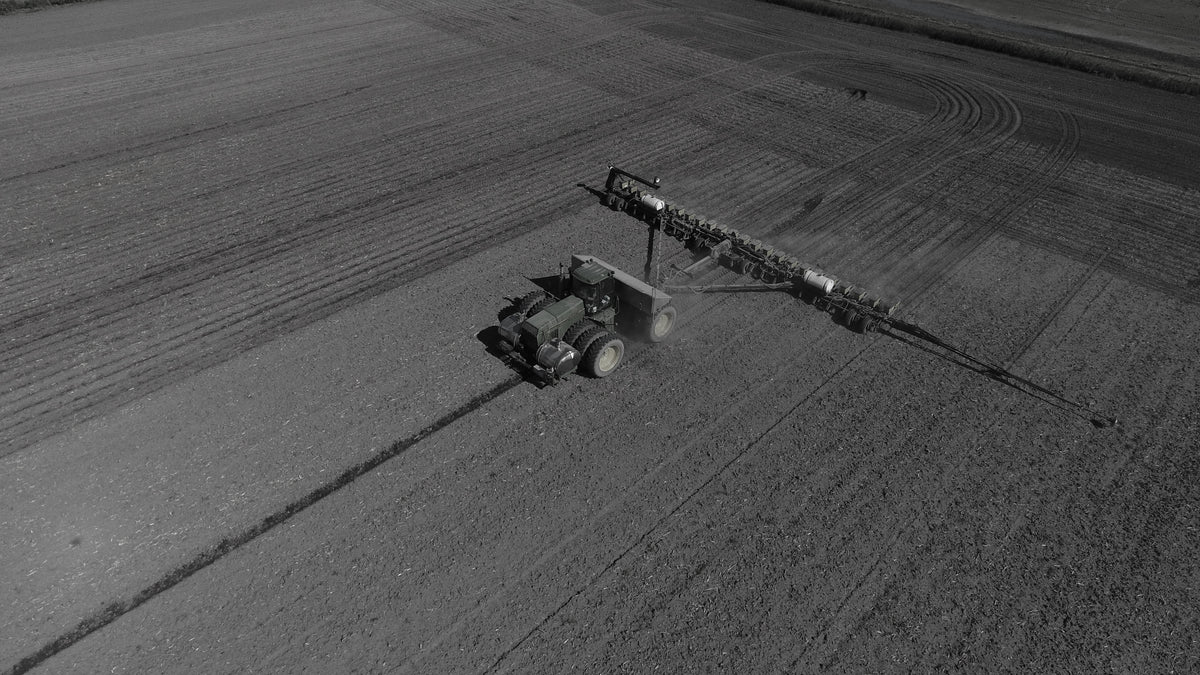
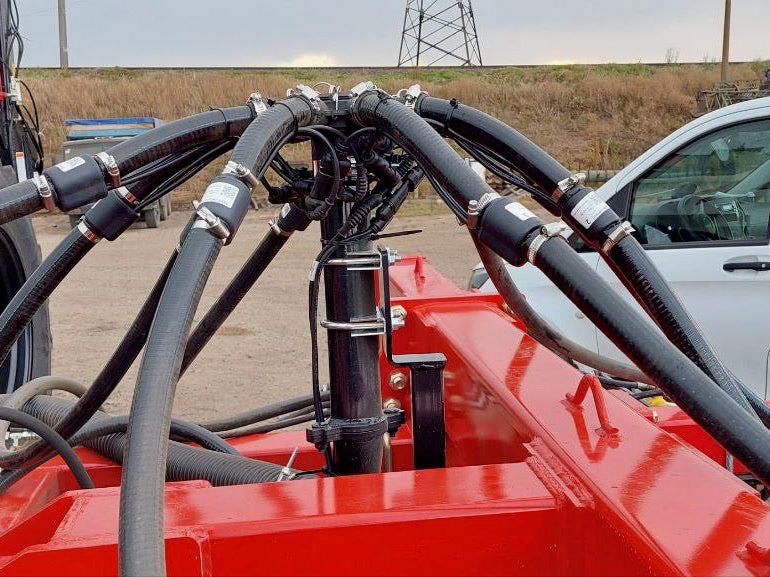
Where does the sensor sit?
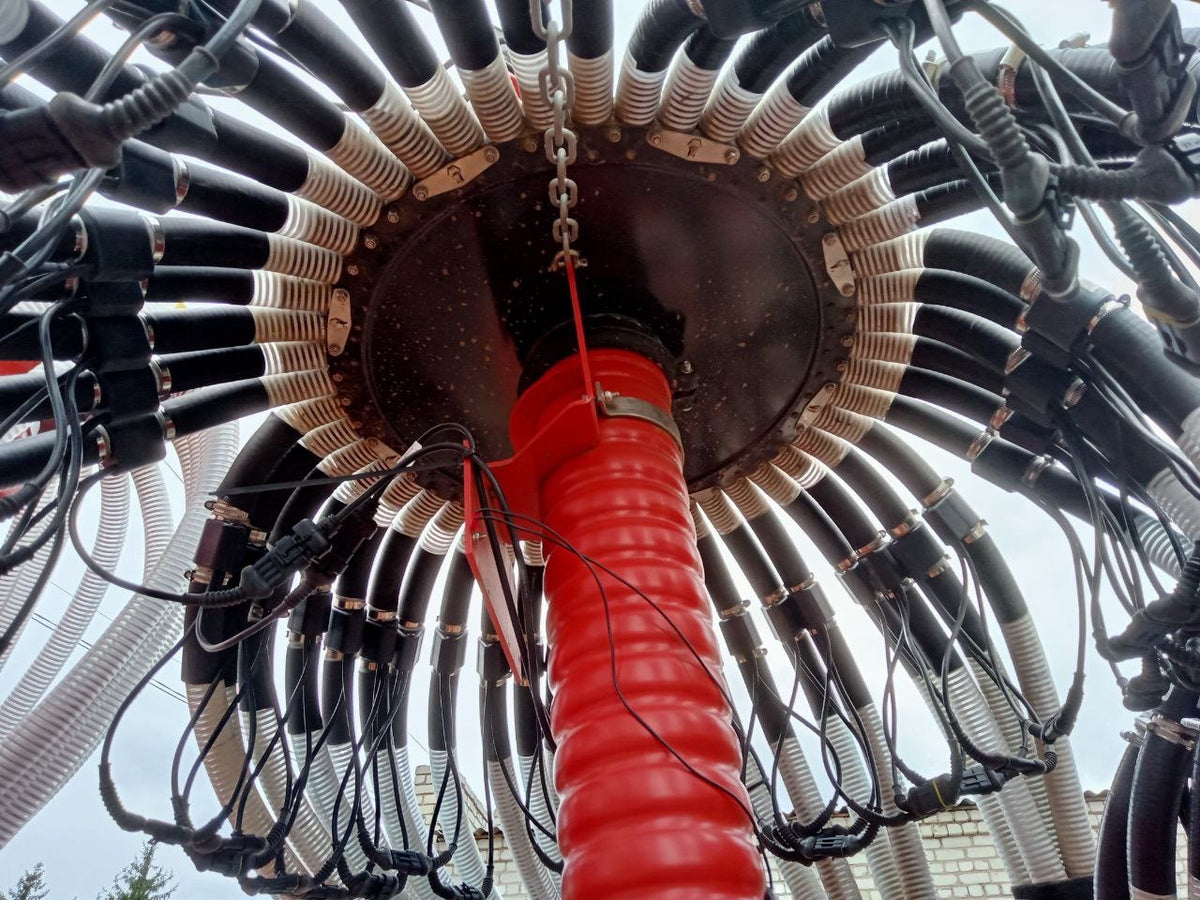
In the seed hose, below the distributor head or the metering unit — one sensor per hose. Seed and fertiliser pass straight through a smooth stainless-steel tube. Sizes for round hoses: Ø25, Ø30, Ø32, Ø35 and Ø50 mm.
How is it wired?
One thin cable runs from sensor to sensor and on to the display in the cab. There are no control boxes or modules in between, and the machine's own wiring is not touched. Power comes from the tractor's 3-pin socket. Large drills, from about 40 rows, get one splitter in the middle.
- 1Sensor in every seed hose
- 2One thin cable from sensor to sensor
- 3Display in the cab
- 4Power from the tractor's 3-pin socket
- 5Fertiliser sensors on the same cable
What do I see in the cab?
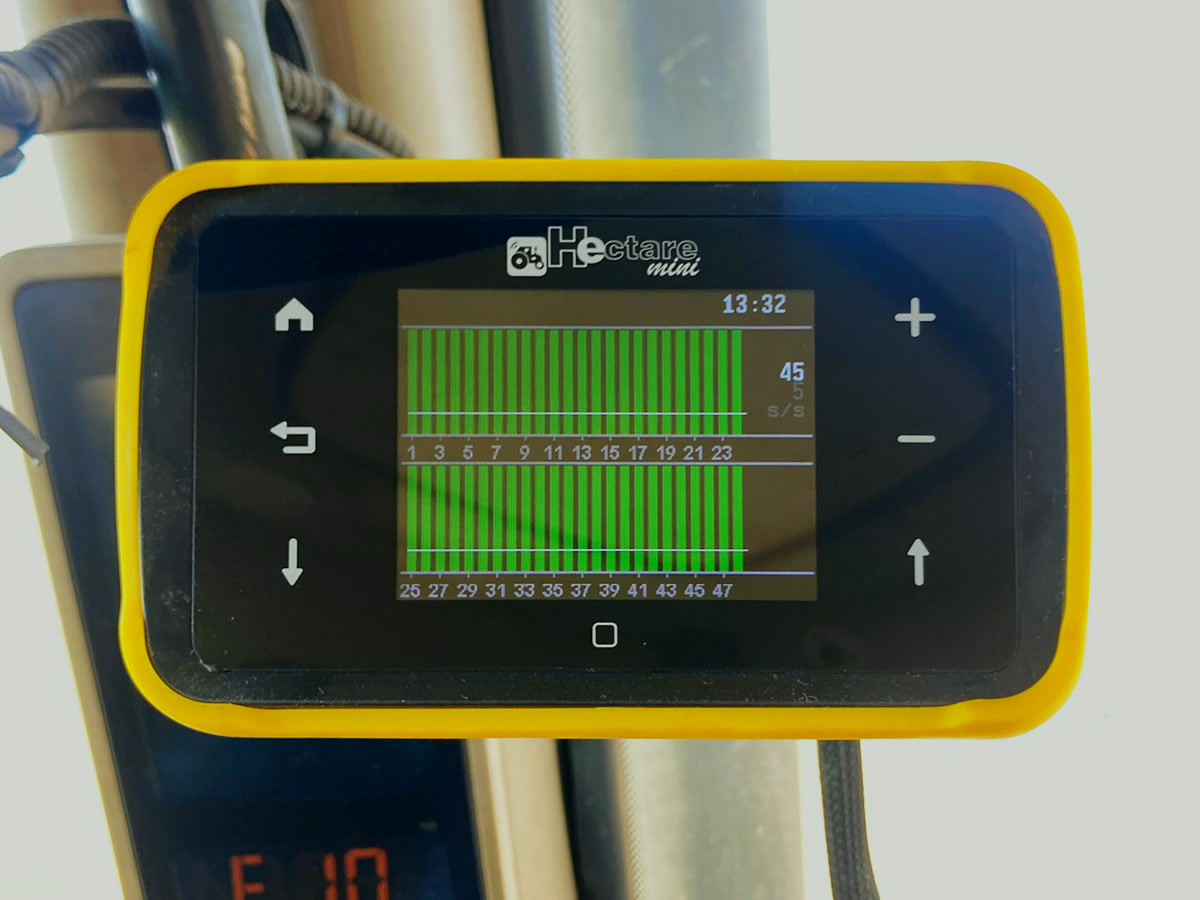
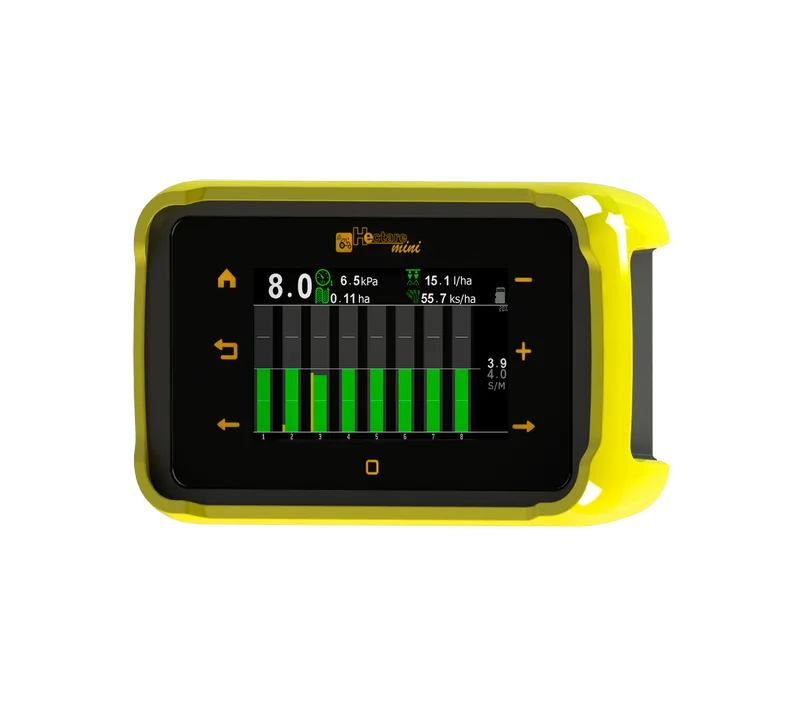
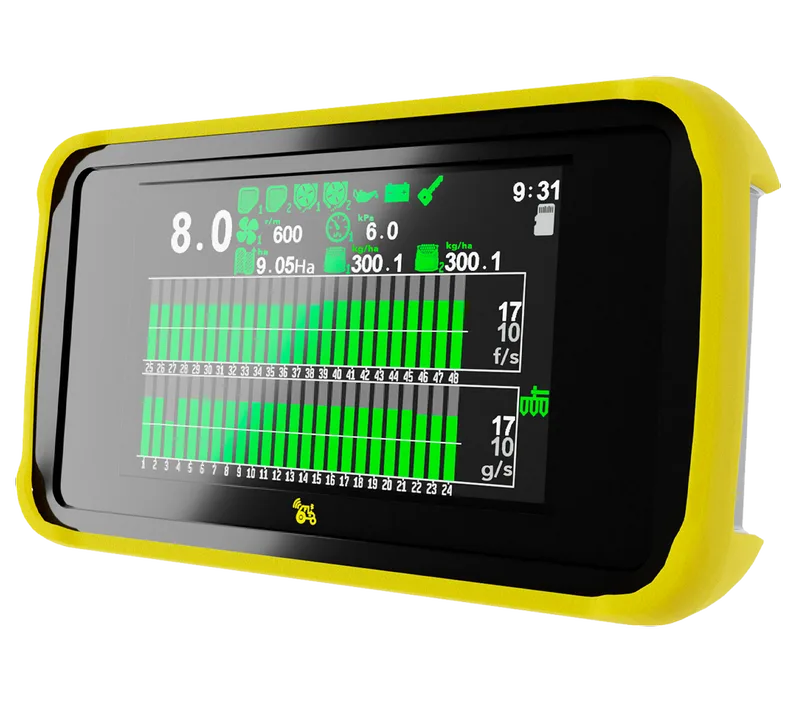
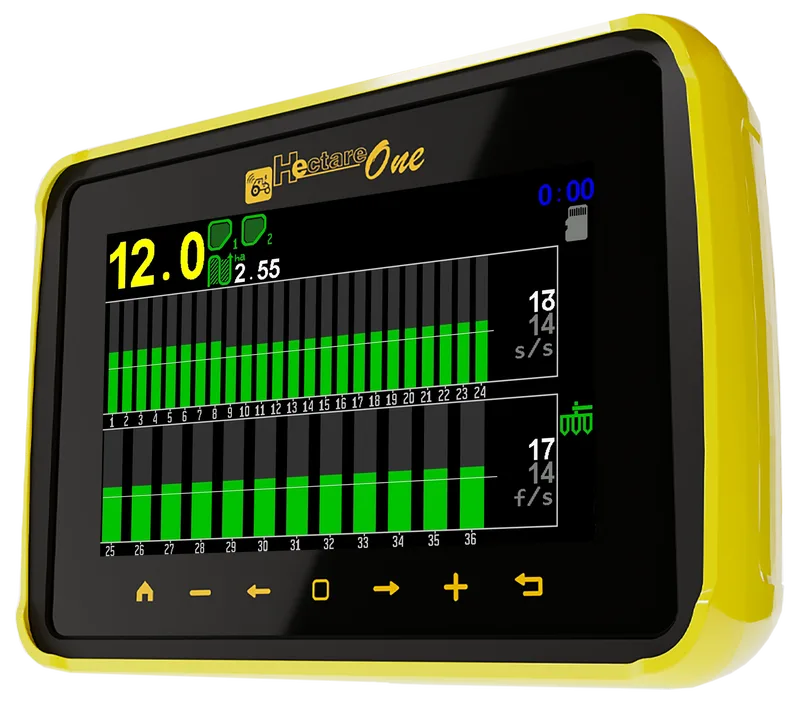
A bar for every row: the more seed flows, the higher the bar. Dry fertiliser is a second set of bars, liquid fertiliser with flow meters a third. Above them: speed, area and, if fitted, hoppers, fan and metering shaft.

Will I notice a blocked row in time?
Yes, usually before it blocks completely: the bar drops and turns yellow. When nothing flows any more, the row flashes red, the display beeps and shows the row number. There is nothing to calibrate — one button press sets the alarm level from the average of all rows.
Will it beep on every headland?
No. The display recognises by itself when you are sowing and when the drill is lifted, and watches the rows only while you sow. Tramline rows are left out. There is no button to forget.
Dust and seed dressing
Dust and seed dressing do not affect the sensor: it adjusts itself and, as a rule, needs no cleaning during its whole service life. If something is wrong with a sensor, the display shows it with the row number.
Cereals or precision seeding?
On grain drills the display shows how evenly every row sows and which row is falling behind. On precision planters it also shows doubles, skips and the number of seeds per hectare.
Which display?
Hectare mini for up to 60 rows, Hectare 5 for up to 160, Hectare ONE for up to 192. All three monitor seed and fertiliser.
Speed, hoppers, fan
The speed sensor has its own input on the display; the Hectare mini can also take speed from its built-in GPS. For hopper level, fan, metering shaft, working position and markers we recommend our own sensors: they are made for the system, and we stand behind the whole chain. From two such sensors they connect through the HUB-8 module.
Sensors of other makes with a switching output can also be connected through HUB-8 — ask us.
How long does fitting take?
About two hours for 24 rows: cut the hose, push the sensor in, secure it with two hose clamps, plug the cables together and run one cable to the cab. The sensors usually come numbered from the factory.
What does it cost?
Sensor for round seed hoses from €120. Display: Hectare mini €410, Hectare 5 €759, Hectare ONE €1.190. Ready-made kits for grain drills from €2.608, for precision planters from €1.160. Prices excl. VAT. The configurator puts together the exact parts list and price for your machine; our engineer checks unusual cases.
Who is behind the system?
Agriwelt, Vienna. The sensors and displays are our own development, built up by a team of engineers over more than 20 years. For many of those years they have worked on farms where the nearest workshop is more than 200 km away and winters go down to −40 °C — where a system has to run without anyone coming to fix it. Systems are in use in Austria, Germany, France and Italy; on request we send photos of installations on your type of machine.
Hectare mini in practice
What’s in the box, and what you see and hear while seeding.
The video loads from YouTube only when you click.
Questions
Do I need ISOBUS?
No. The system works standalone with its own display.
Is there a subscription or activation fee?
No.
What if a sensor fails?
You replace just that sensor. The new one gets the row number in the display menu.
Can the system also control the rate?
Yes, for seed and dry fertiliser, with Agriwelt drive controllers and electric motors. Rate control
Will it fit my machine?
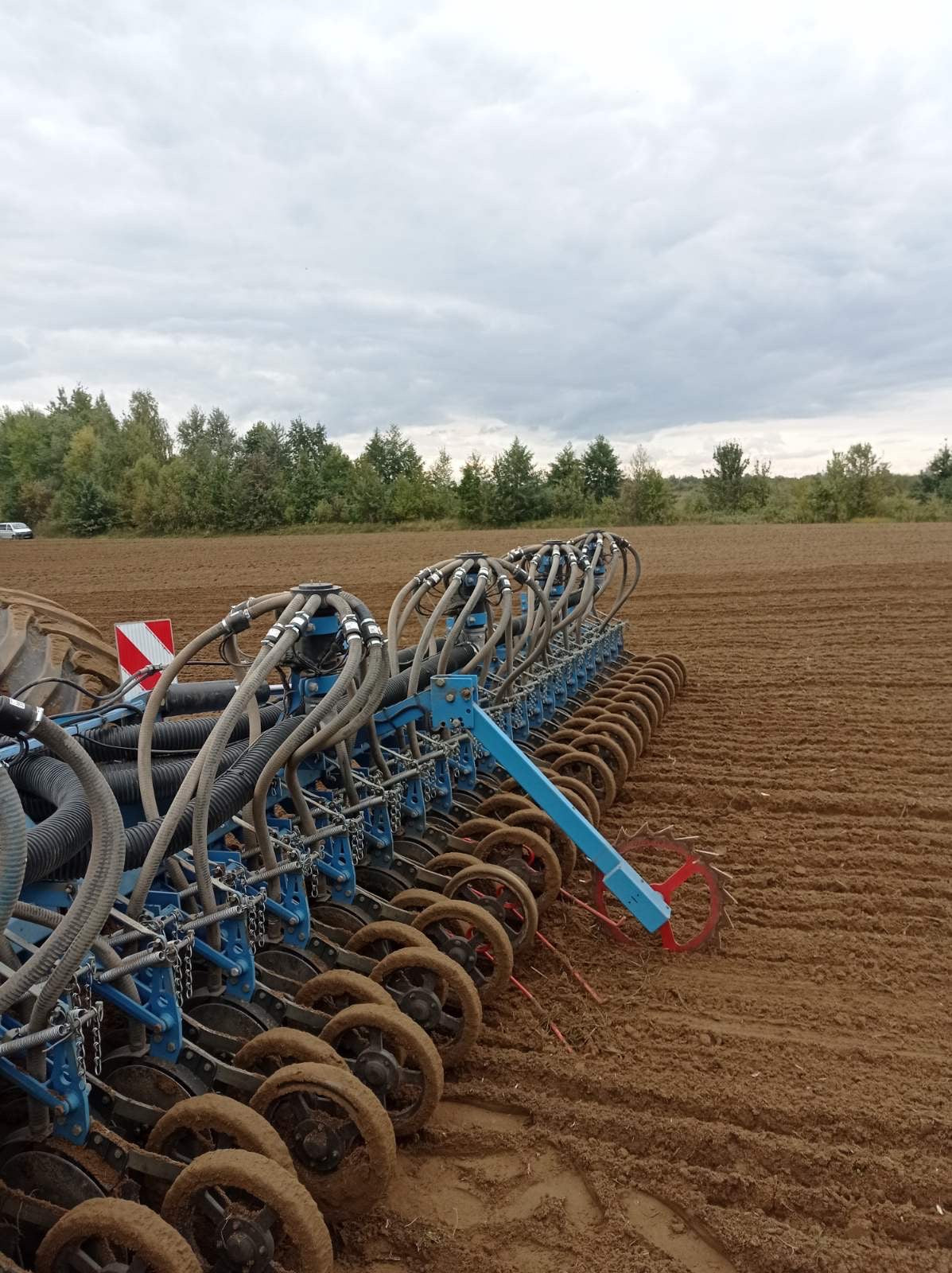
Drills and planters with seed hoses, including older and modified ones. We know seeding systems; compatibility with your machine is confirmed individually, from photos if needed.